Process-generated fume and gas
Welding, cutting, gouging, and related hot work can create fumes and gases that need practical control, not just a generic note in the pack.

Fabora resources
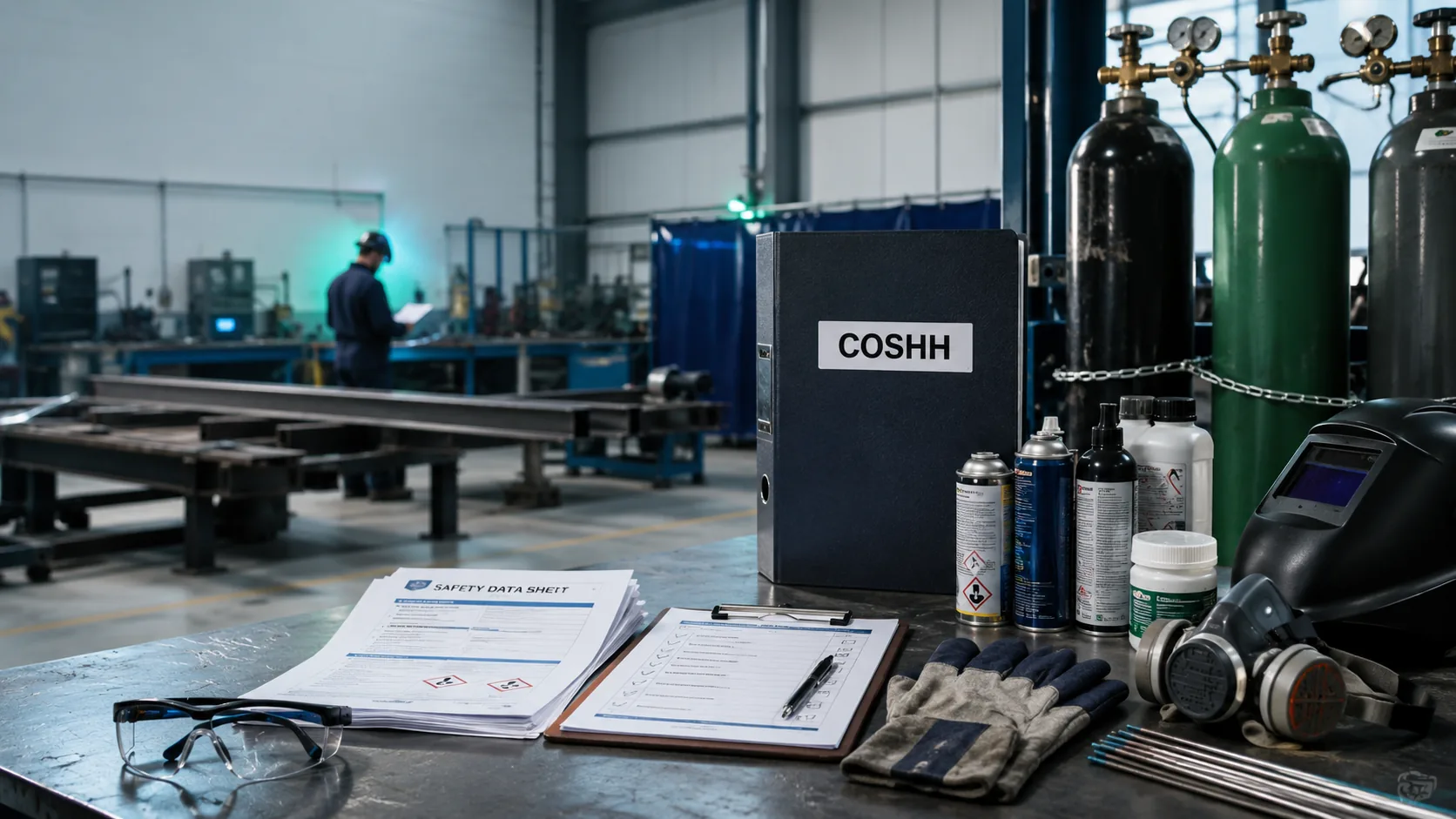
For steelwork businesses, COSHH is not just about a folder of product sheets. It is about understanding what harmful substances are present, how people are exposed during the real task, what controls are meant to work, and how the materials are stored, handled, and reviewed on the ground.
Short answer
Steelwork teams often need to think about both supplied substances and process-generated exposure. That can include welding fume, gases, anti-spatter products, cleaners, coatings, grinding dust, and the way cylinders or consumables are handled around the job.
Practical summary
Steelwork teams often need to think about both supplied substances and process-generated exposure. That can include welding fume, gases, anti-spatter products, cleaners, coatings, grinding dust, and the way cylinders or consumables are handled around the job.
Free download
Editable and free, with no signup. Fill it in for your job, then keep it for the next one.
Stop re-typing it every job
The template is a good start. Fabora RAMS turns it into reusable, editable RAMS you build in minutes, with saved hazard, COSHH and PPE libraries, branded PDF export and revisions, instead of editing the same Word file every time.
What sits under COSHH
Some hazardous substances arrive in a container. Others are created by the job itself. Both need to be thought through properly. The related welding risk assessment template linked later on this page shows how fumes, gases, consumables and COSHH points can feed into the wider job assessment. The toolbox talk topics guide can help explain those exposure controls in plain English during team briefings.
Welding, cutting, gouging, and related hot work can create fumes and gases that need practical control, not just a generic note in the pack.
Cleaners, anti-spatter products, paints, primers, degreasers, and similar items often need review around storage, use, ventilation, and contact risk.
Wires, rods, fluxes, coatings, and the residues left behind by the process can all change what exposure routes and housekeeping controls matter most.
Shielding gases and related equipment bring handling, storage, connection, and leak-management points that should be part of the practical review.
Practical review
The practical review is normally where teams get value. It connects the paperwork to the actual task.
List the supplied products and process-generated hazards that are relevant to the task, then connect the SDS details, COSHH register, and what the work itself produces.
Think about inhalation, skin contact, eye contact, accidental contamination, and whether exposure changes with the location or duration of the work.
Ventilation, LEV, handling rules, PPE, storage, labelling, segregation, spill or leak response, and housekeeping all need to be realistic for the workface.
The team using the materials should know the key hazards, controls, and what to do if the task changes or something goes wrong.
Consumables and handling
These are common steelwork examples where a quick generic note can be too light.
Storage, securing, transport, connection, and leak awareness need to fit the actual work area, whether that is a workshop bay or a mobile site task.
The material itself may be straightforward, but the way it is used, heated, sprayed, or stored can still change the exposure and housekeeping picture.
The condition of the steel can change the fume and surface hazard profile, so the review should not stop at the standard welding process alone.
Steelwork teams often focus on inhalation first, but skin and eye exposure from sprays, liquids, and contaminated gloves can also be part of the real risk.
Common mistakes
The usual problem is not having no paperwork. It is relying on paperwork that never really gets tied to the actual job.
The product sheet helps, but the team still needs to think about how the substance is being used, heated, moved, or stored in the actual work area.
Some of the important harmful substances are created during the work, such as welding fume, rather than arriving in a labelled container.
Poor cylinder control, unlabelled decanting, badly stored aerosols, or mixed material storage can create avoidable problems before the task even starts.
A new spray, coating, consumable, or steel condition can change the exposure picture. The review needs updating when the real job changes.
Official guidance
These links point to the underlying official material. This page is a practical summary, not a replacement for those sources, competent review, or legal advice.
Useful HSE overview on identifying hazardous substances, process-generated exposure, exposure routes, and practical assessment points.
Useful HSE context around welding-related hazardous substances, including fume, gases, fluids, and confined-space concerns.
Useful HSE overview where welding fume is part of the COSHH picture for the job.
Useful for wider guidance on gas handling, storage, and use around welding and allied processes.
FAQ
Short answers on practical use, review expectations, and where this guidance stops.
Important note
Final review, suitability, and approval still remain with the customer's business and the people responsible for the job.
No. It also covers harmful substances created by the work itself, such as fumes, gases, dusts, vapours, and similar process-generated exposure.
No. The SDS is useful input, but the business still needs to review how the substance is used, who is exposed, and what practical controls are needed in the real task.
Review what it is, how it will be used, the likely exposure routes, the storage and handling requirements, and whether the existing controls and PPE still make sense.
A practical register should list relevant welding consumables, gases, sprays, cleaners, coatings, SDS details, storage points, exposure routes, current controls, PPE, review dates, and who has checked the information for the actual workshop or site task.
COSHH information often feeds into the RAMS pack so the team can see the relevant substances, controls, handling points, and precautions inside the wider job method.
Related reading
These links keep the topic moving, either into related guidance or into the Fabora RAMS product pages.
Useful if the main control question is welding fume, extraction, and workshop ventilation.
Useful where welding fumes, gases, consumables and COSHH items need to feed into the wider risk assessment.
Use the free checklist tool to review welding fumes, gases, consumables, PPE, equipment and COSHH controls before drafting RAMS.
Useful where welding fumes, gases, consumables and exposure controls need to be explained in plain English.
Useful if you want a practical RAMS structure that can carry COSHH, PPE, substance, and control prompts into the job pack.
Useful where COSHH controls overlap with machinery use, guarding, cleaning, maintenance, or workshop supervision.
Useful if you need the wider picture on how COSHH information fits into a workable RAMS pack.
See how Fabora RAMS helps teams structure COSHH items, controls, and repeat drafting inputs more clearly.