Risk assessment section
This part identifies the main hazards, who could be harmed, how serious the risk could be, and what controls are needed before and during the work.

Fabora resources
If you are looking for a RAMS template UK starting point, this guide explains the structure a practical risk assessment and method statement template should cover for steel fabrication, site welding, steel erection, and related site-working metal trades. It is written as an editable RAMS template guide, not as automatic approval or legal sign-off.
Short answer
A RAMS template can help you start with a clear structure, but the final pack still needs job-specific editing, competent review, and business approval before it is issued or used on site.
Practical summary
A RAMS template can help you start with a clear structure, but the final pack still needs job-specific editing, competent review, and business approval before it is issued or used on site.
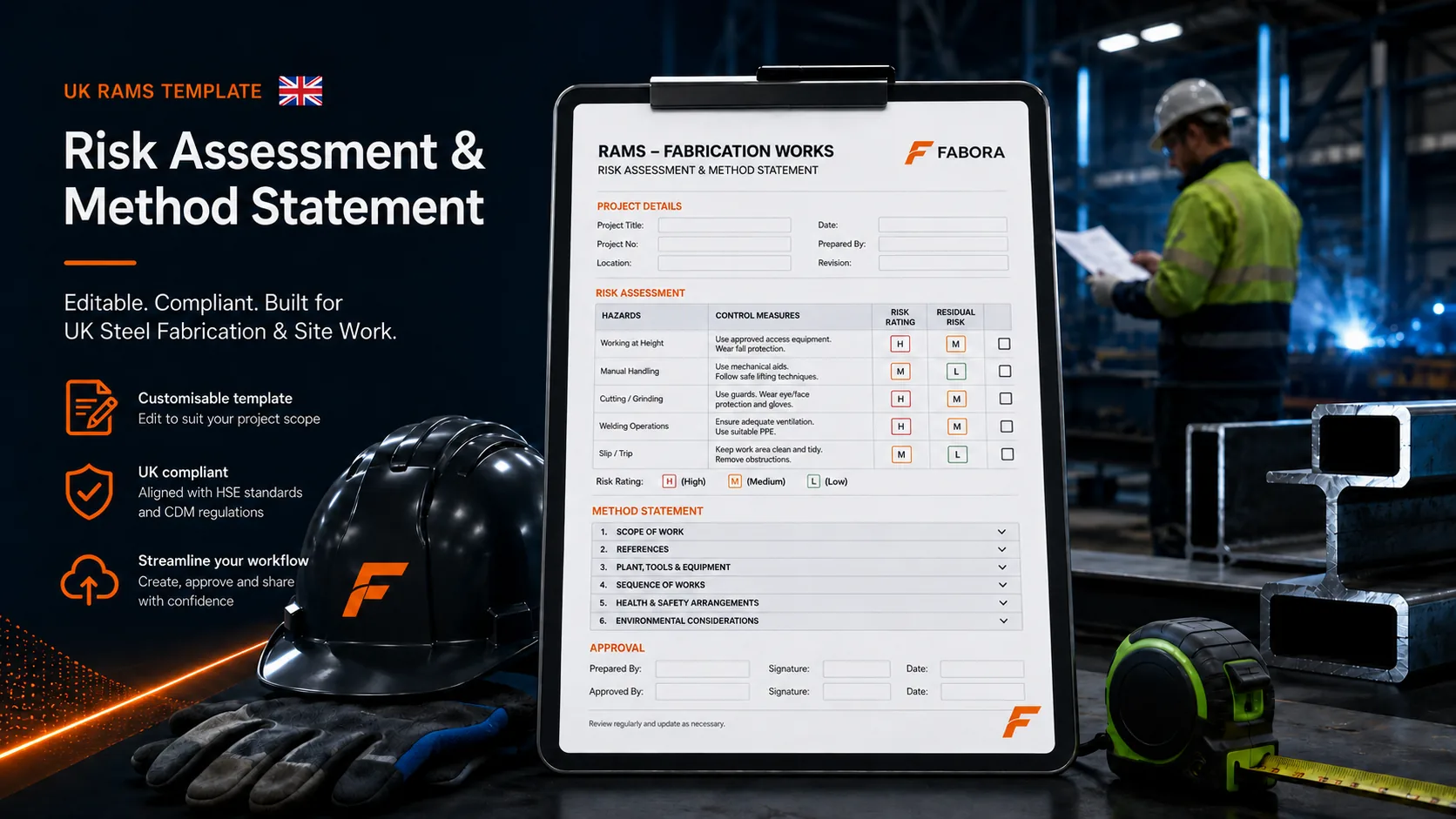
Free download
Editable and free, with no signup. Fill it in for your job, then keep it for the next one.
Stop re-typing it every job
The template is a good start. Fabora RAMS turns it into reusable, editable RAMS you build in minutes, with saved hazard, COSHH and PPE libraries, branded PDF export and revisions, instead of editing the same Word file every time.
Template basics
A RAMS template is a reusable structure for writing a risk assessment and method statement. The template helps you avoid starting from a blank page, but it still needs to be edited around the real task, location, people, equipment, and controls.
This part identifies the main hazards, who could be harmed, how serious the risk could be, and what controls are needed before and during the work.
This part explains how the job will be carried out in sequence, including access, preparation, equipment, supervision, hold points, and handover.
A RAMS template becomes useful only when it is edited for the actual project, including the address, work area, client rules, permits, contacts, and emergency arrangements.
The template is only a starting point. Final review and approval stay with the business and competent people who understand the work and site conditions.
UK structure
A practical UK RAMS template should be structured enough for review and plain enough for the people doing the work to understand. For construction and steelwork jobs, the best structure is usually HSE-informed without pretending to be automatic legal compliance.
Include company name, project name, site address, work area, client or principal contractor details, responsible people, start date, review date, and document revision.
Describe what the RAMS covers and what it does not cover. This is especially important for mixed jobs involving fabrication, delivery, site welding, and steel erection support.
List the main hazards and practical controls, including access, lifting, hot works, welding fume, fire risk, noise, manual handling, plant, tools, and other trades nearby.
Show who is involved, what competence or supervision is expected, which equipment will be used, and which materials, consumables, PPE, and COSHH items apply.
Set out the method statement template in a clear sequence so supervisors and operatives can follow the work from arrival and setup through to completion and close-out. See the method statement template guide linked later on this page if you want a more detailed breakdown of the working sequence.
Cover first aid, fire arrangements, emergency contacts, welfare, site induction, permits, isolation, exclusion zones, and any client or principal contractor rules.
Checklist
Use this free RAMS template UK checklist as a practical review aid before you issue a draft. It is not a replacement for your company process, but it helps catch common gaps.
Check dates, addresses, client names, project numbers, contacts, site rules, emergency points, revision numbers, and copied references from previous jobs.
Read the method steps in order and ask whether that is how the team will actually fabricate, deliver, weld, erect, inspect, clean up, and leave the work area.
A construction RAMS template for a live site should not leave workshop assumptions in place. A workshop pack should not include site permit wording that does not apply.
For a welding RAMS template, check permits, fire precautions, fire watch, fume control, gas storage, PPE, electrical setup, screens, and end-of-shift checks.
For steel erection RAMS or delivery work, check lifting points, equipment, exclusion zones, access equipment, temporary stability, weather, and nearby trades.
A template can look complete while still being wrong for the job. Competent review is still required before the RAMS is issued or used.
Steelwork use
Steelwork teams often need more detail than a generic risk assessment method statement template provides. The template should reflect the work type rather than treating every task as ordinary construction admin.
Workshop fabrication RAMS often need detail around cutting, drilling, grinding, welding, material handling, benches, extraction, workshop traffic routes, housekeeping, and fixed plant.
Site welding RAMS usually need stronger job-specific detail around hot works permits, fire risk, fume control, screens, other trades, public interfaces, shutdown checks, and site rules.
Steel erection RAMS should make the sequence, lifting arrangements, temporary stability, access, bolting, fixing, exclusion zones, and weather limits clear enough for site review and use.
Balustrades, staircases, mezzanines, gates, remedials, and installation support may all need the RAMS template edited around access, fixing methods, public exposure, and coordination with other trades.
Template risks
A copied RAMS template can save time, but it can also carry old assumptions into a new job. The risk is not the template itself. The risk is treating the template as finished before it has been properly reviewed.
Copied templates often retain old site details, contacts, dates, drawings, permit notes, equipment lists, COSHH items, and emergency arrangements because the document already looks full.
Controls that made sense for a workshop bay may not suit a live construction site. Controls written for one client site may not suit another.
A method statement template only helps if the sequence follows the work. Fabrication, site welding, erection, remedials, and deliveries can all change from job to job.
When a template contains too much generic wording, reviewers and supervisors have to work harder to find the parts that actually matter for the live task.
Fabora RAMS
A free RAMS template can be a useful starting point. For teams creating RAMS regularly, Fabora RAMS gives a faster editable software route with reusable company libraries and job-specific editing.
Fabora RAMS helps teams reuse saved company details, hazards, controls, PPE, equipment, COSHH items, and method wording instead of copying old files each time.
The workflow is built around site-specific editing, so the pack can be adjusted for the actual site, workshop task, client rules, access, lifting, welding, and sequence.
Teams can create a cleaner PDF export, share RAMS on site, and keep revision history clearer than a chain of copied files and email attachments.
Fabora can speed up drafting, but it does not replace competent review, client expectations, or approval by the people responsible for the work.
Before issue
Before a RAMS template is issued, check that the document has moved from generic draft to job-specific RAMS for the real work.
If the supervisor or operative cannot understand the sequence, controls, permits, and stop points quickly, the RAMS probably needs clearer editing.
Look again at other trades, client operations, deliveries, lifting windows, hot works areas, public exposure, access restrictions, and emergency routes.
Make sure permits, COSHH information, lifting details, drawings, inductions, training records, and equipment checks are aligned with the RAMS where they are needed.
Show who prepared, reviewed, approved, and revised the document so the issued version is clear and old drafts do not keep circulating.
Official guidance
These links point to the underlying official material. This page is a practical summary, not a replacement for those sources, competent review, or legal advice.
Useful HSE context on how method statements support planning, monitoring, and communication on construction work.
Useful when thinking about how RAMS fit into wider construction planning and coordination.
Useful for site RAMS where inductions, local rules, permits, traffic routes, and emergency arrangements need to be reflected.
Useful where a welding RAMS template needs to consider fume, gases, noise, and related health controls.
FAQ
Short answers on practical use, review expectations, and where this guidance stops.
Important note
Final review, suitability, and approval still remain with the customer's business and the people responsible for the job.
No. A RAMS template is only a starting structure. It still needs job-specific editing, competent review, and approval by the business responsible for the work before it is issued or used.
A RAMS template should usually include project details, scope, hazards, controls, people, plant, materials, PPE, COSHH items, method steps, permits, emergency arrangements, review details, and revision control.
You can reuse a company structure, but each job should be reviewed and edited. Site access, welding controls, lifting arrangements, emergency details, permits, and client rules can all change between jobs.
Usually, yes. Workshop RAMS often focus on fixed work areas, plant, extraction, handling, and premises arrangements. Site RAMS usually need more detail around access, permits, interfaces, changing conditions, and site rules.
Fabora RAMS helps steelwork teams build editable RAMS faster using reusable company libraries and job-specific editing. It supports the drafting workflow, while final review and approval still stay with the business.
Related reading
These links keep the topic moving, either into related guidance or into the Fabora RAMS product pages.
See the editable RAMS software route for UK steel fabricators, site welders, steel erectors, and related trades.
Use the free checklist tool to review RAMS content, hazards, method steps, PPE, COSHH, permits and approval points before issue.
Useful if you want a practical method statement structure to sit alongside your RAMS template.
Useful if your RAMS need a practical welding risk assessment structure covering fumes, hot works, PPE, COSHH and equipment.
Compare the Free and Pro routes if you want to move beyond copied RAMS templates.
Read the broader guide to what a usable RAMS pack usually covers for steelwork teams.
Go deeper on workshop and site RAMS for steel fabrication businesses.
Understand why workshop and site RAMS often need different detail and different starting points.
Useful if your RAMS template needs to cover hot works, fire precautions, and site welding coordination.