Short and focused
Short enough that people stay with you, clear enough to land the hazard, the control and what they need to do about it.
Fabora resources
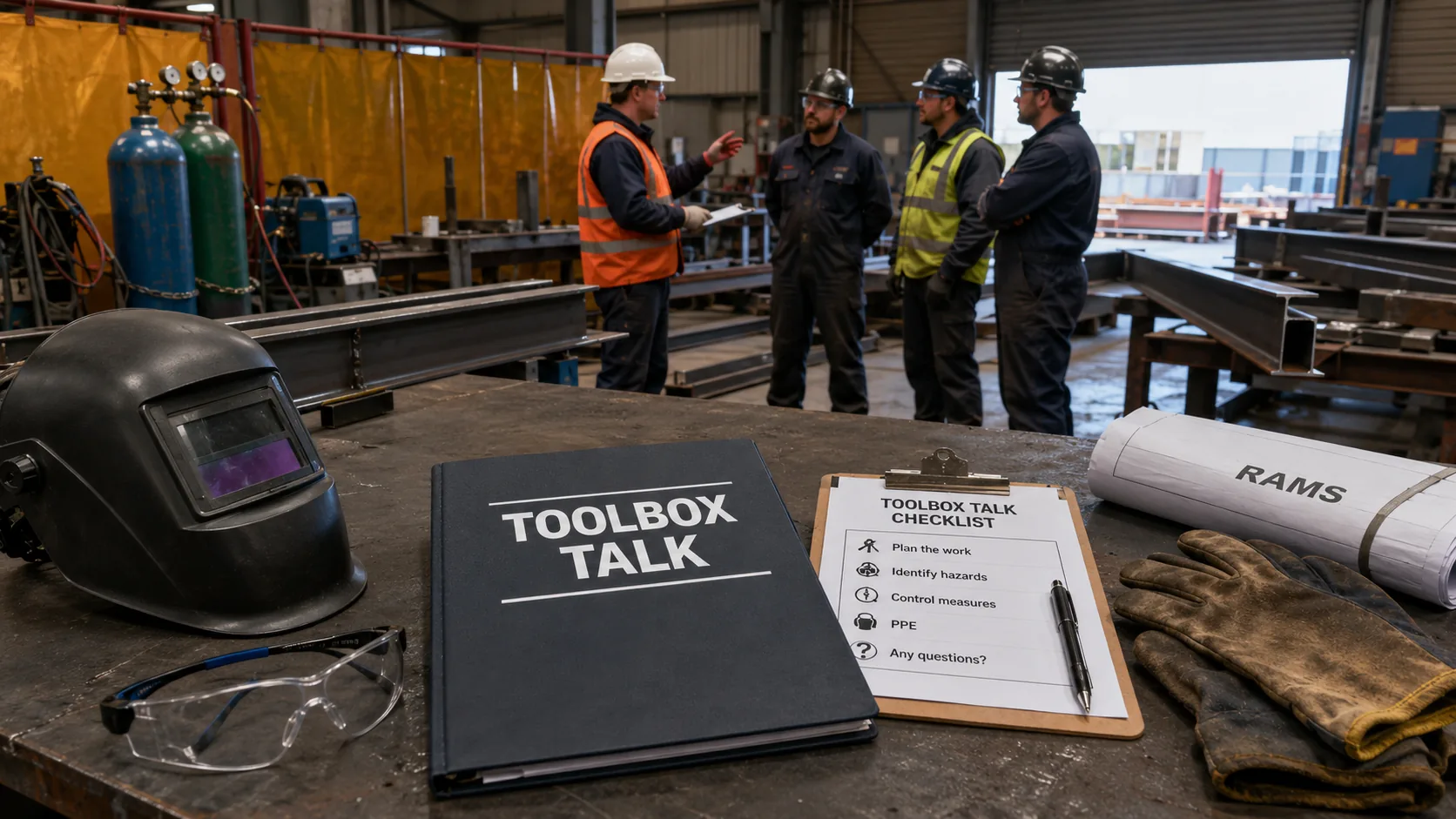
A toolbox talk is a short safety briefing, five minutes before the job, or when something changes mid-shift. For welding, fabrication, steel erection and site work, the ones that land stay close to the actual task and the controls the team's about to use. The ones people switch off in are the generic scripts read out for the record.
Short answer
Toolbox talks work when they're short, relevant and tied to the real job: the RAMS, the risk assessment, the method statement and what the site's actually like today.
Practical summary
Toolbox talks work when they're short, relevant and tied to the real job: the RAMS, the risk assessment, the method statement and what the site's actually like today.
Free download
Editable and free, with no signup. Fill it in for your job, then keep it for the next one.
Stop re-typing it every job
The template is a good start. Fabora RAMS turns it into reusable, editable RAMS you build in minutes, with saved hazard, COSHH and PPE libraries, branded PDF export and revisions, instead of editing the same Word file every time.
Plain English answer
A short safety briefing (one topic, one task, or one thing that's changed) so the team's clear on what matters before they crack on.
Short enough that people stay with you, clear enough to land the hazard, the control and what they need to do about it.
The site weld going in this morning, the lift at 11, the new bandsaw, the hot works permit. Not a topic pulled at random off a list.
PPE, exclusion zones, permit checks, equipment checks, the emergency points, and what makes everyone stop.
It backs up the RAMS, risk assessment and method statement. It's not a shortcut round doing the planning properly.
Why it matters
Steelwork jobs move. A five-minute briefing is how you reconnect the RAMS and site rules to what's actually in front of the team this morning.
Access, other trades, weather, materials, delivery routes, permit conditions: plenty shifts between the office writing the RAMS and the team turning up.
Fume, fire, UV, burns, electric shock, gases, grinding: one task, several hazards, all live at once. Worth a reminder.
Guarding, emergency stops, isolation, LEV checks, COSHH, housekeeping: these run on day-to-day discipline, and discipline slips without the odd nudge.
A decent talk lets someone say "that's not how it is out there" before the method drifts away from the real job.
Welding topics
Best when they're about the process, the spot and the controls being used that day. Here are the ones worth rotating through.
The fume source, the material, how long the run is, extraction or ventilation, RPE where it's needed, and keeping the labourer out of the plume. Mild steel fume is a carcinogen, worth saying out loud.
Screens, lens shade, and the bloke who looks over without a mask and wakes up at 2am with eyes full of grit. Arc eye usually hits the bystander, not the welder.
Hot workpieces, slag, spatter, gauntlets, marking up hot steel so the next person doesn't grab it, and where the hot offcuts go.
Cylinders secured and apart, hoses and regulators checked, flashback arrestors on. And on the electric side: leads, return clamps, wet conditions, and pulling damaged kit out of use.
Permit, extinguisher, combustibles, the gaps sparks drop through, and holding the fire watch after the arc stops. Smouldering fires turn up later.
Ventilation, access, rescue, fume and gas build-up, and whether the agreed method still works once you're in a tight spot.
Workshop topics
Keep these on the machinery, the material moving around, and the controls people lean on every shift.
Fixed and adjustable guards, interlocks, blade and wheel guards, and the fact that tying one back to save thirty seconds is how people lose fingers.
Where the stops are and that they have to stay reachable. And isolating properly before cleaning, blade or die changes, clearing jams or maintenance, including stored energy.
Bandsaws: clamping, blade condition, hand position, clearing offcuts. Pedestal drills: loose clothing and gloves near rotating parts, workpiece restraint, speed.
Right wheel, checked wheel, guard and rest set, face protection, vibration, and binning damaged discs instead of nursing them along.
Sharp plate, burrs, awkward sections, team lifts and aids, plus the trailing leads, swarf and offcuts that put people on the floor.
Segregation, reversing, banksman, and where pedestrians don't stand. And the extraction: positioned right, not blocked, capturing at source. Flag it when it's weak.
Site topics
Tie the planned sequence to the live site, especially where lifting, access, weather or other trades are in play.
The lift route and load path, who's involved, comms, the exclusion area, tag lines, and who actually controls the lift. Nobody under the load.
Pre-use checks, tags, SWL, sling angle, attachment, and what to do when a sling looks wrong, which is set it aside, not chance it.
Access method, edge protection, fall prevention, the rescue plan, dropped objects, and the point where you stop. MEWP talks add ground conditions, harness where required and overhead obstructions.
Bracing, temporary supports, bolt-up, hold points, the drawings, and not changing the erection sequence on the hoof without a review.
Vehicle routes, unloading, banksman, load stability. Plus wind limits, ice, visibility, ground bearing, and who calls it when the job should pause.
Nearby work, the public, shared access, keeping spare bodies clear, and the site basics: welfare, first aid, fire, muster points, permits, emergency routes.
Risk areas
If you're building a briefing rota, grouping by risk area rather than trade gives you a year's worth without repeating yourself.
Masks, gloves, eye and ear protection, FR clothing, RPE fit and storage. Plus the COSHH side: fume, gases, sprays, cleaners, coatings and the data sheets behind them.
Permit, combustibles, screens, extinguishers, fire watch, hidden voids and the final area check.
Awkward steel, sharp edges, team lifts, mechanical aids, pinch points, and not rushing the move because the crane's waiting.
Access, edge protection, MEWPs, towers, dropped objects, rescue. And lifting: lift plans, accessory checks, SWL, exclusion zones, load control.
Guarding, emergency stops, isolation, maintenance, defects and machine-specific safe use. Plus hand-arm vibration from grinding and cutting: duration, tool condition, reporting tingling early.
First aid, fire response, muster points, stop-work triggers, and reporting near-misses without anyone getting a bollocking for it.
Example structure
Six points, run in order, and you've covered a proper talk without it dragging. Edit it round the live job.
Name the topic, the job, the area, and why you're briefing it now.
The two or three that matter for this task, not a recital of every risk on site.
What's in place, who owns it, and what to do if the control's missing or not working.
PPE, RPE, tools, access equipment, lifting gear or fire kit to check before you start.
Site rules, permits, nearby trades, access, welfare, emergency contacts, any local restriction.
Ask one or two questions, let people flag anything that doesn't match the RAMS, then record attendance if the job calls for it.
RAMS link
RAMS set out the hazards, controls and sequence. The method statement covers how the work's done; the welding risk assessment covers the welding hazards. The toolbox talk is how you get the key points off the page and into the team's heads.
Start from the live pack so the talk matches the agreed hazards, controls, PPE, COSHH, equipment and method, not a half-remembered version.
The method statement template for steelwork in the related links covers the sequence; the welding risk assessment template gives you the fume, fire, PPE and equipment points to drop in.
If the area, people, kit, access, material, permit or method has moved, pause the talk and get the RAMS looked at before carrying on.
Fabora RAMS
It gives the team one reviewed source of hazards, controls and method to brief from. The sign-off still sits with you.
Company details, customers, sites, contacts and repeat job info live in one place, so briefings come off controlled RAMS rather than an old copied file.
Reusable libraries keep the briefing points consistent before you tailor them to the job in hand.
Edit the method round the real workshop or site sequence, then use it as the reference when you run the talk.
Export, share and revise the pack so the supervisor's briefing from the current version, not last month's print-out.
Running the talk
Talks land when they're about the work happening now. Keep them short, tie them to the RAMS, and don't turn them into paperwork read out for the file.
Pick one task, land the main hazard and control, and stop. Cover six things and they'll remember none.
Start from the RAMS or risk assessment, then make it specific to this area and this crew. Generic talks get the generic nod and nothing else.
One or two straight questions to check it's landed, and to give someone the chance to say something's not right.
Attendance or a quick note where your process, the site or the client asks for it.
New equipment, access, people, weather, permit or method: pause, sort the RAMS, then carry on.
A printed talk that doesn't match the work gets ignored. The five-minute one about the actual job beats it every time.
Official guidance
These links point to the underlying official material. This page is a practical summary, not a replacement for those sources, competent review, or legal advice.
Useful HSE context where toolbox talks sit alongside site rules, induction, local arrangements and communication on construction sites.
Useful HSE context on method statements, briefings and communication around planned work.
Useful HSE background where welding toolbox talks cover welding fume, gases, noise, vibration, eyes, skin and health risks.
Useful HSE guidance where toolbox talks cover welding fume control, ventilation, RPE and nearby workers.
FAQ
Short answers on practical use, review expectations, and where this guidance stops.
Important note
Final review, suitability, and approval still remain with the customer's business and the people responsible for the job.
A short safety briefing on one topic, task or work area. It reminds the team about the hazards, controls, PPE, emergency points and site rules that matter before or during the job.
Fume and ventilation, RPE, welding PPE, arc eye, burns and hot metal, gas cylinders, damaged leads, grinding and cutting, the hot works permit, fire watch, and keeping the welding bay clear.
Machinery guarding, emergency stops, isolation and lock-off, bandsaws, pedestal drills, grinders and abrasive wheels, manual handling, forklift movement, slips and trips, swarf and offcuts, and LEV checks.
Lifting operations, slings and chains, exclusion zones, working at height, MEWPs, temporary stability and sequence, dropped objects, deliveries and unloading, weather and ground conditions, and the site emergency arrangements.
Short. Long enough to land the hazard, the control and the site-specific point (usually a few minutes) and no longer. The moment it turns into a lecture, people stop listening.
They're a common way to brief and communicate, and what you need to record depends on the work, the site and the client. They aren't automatic legal approval. And no, they don't replace RAMS: they back up the risk assessment and method statement, they don't stand in for competent planning, supervision or your sign-off.
Related reading
These links keep the topic moving, either into related guidance or into the Fabora RAMS product pages.
See how Fabora RAMS keeps editable RAMS content, hazards, PPE, COSHH, equipment and method steps easier to organise.
Create a practical toolbox talk outline for welding, steelwork, hot works, COSHH, PUWER, LOLER or site-work briefings.
Use the free checklist tool to review welding hazards, fume controls, hot works, PPE, COSHH and equipment before briefing the team.
Use the free checklist tool to review RAMS content before turning key hazards, controls and method points into a briefing.
See the Fabora RAMS plans if you want reusable RAMS content to support regular briefings and site communication.
Useful if you need the wider RAMS template structure that toolbox talks should support rather than replace.
Useful where toolbox talks need to brief the work sequence, people, equipment, controls and review points.
Useful where welding toolbox talks need to cover fumes, fire risk, PPE, COSHH, equipment and site controls.
Useful for turning site welding RAMS points into short briefings before work starts.
Useful where toolbox talks need to cover fire controls, fire watch, permit conditions and close-out checks.
Useful where welding fumes, gases, consumables and exposure controls need plain-English briefing points.
Useful for toolbox talks around guarding, emergency stops, isolation, maintenance and workshop equipment checks.
Useful for toolbox talks around lifting operations, accessories, exclusion zones and load control.
Useful if workshop safety talks need to connect with wider fabrication RAMS and job-specific review.
Useful where toolbox talks need to cover lifting, access, temporary stability and site installation sequence.