

1,017.4 mm, or 40 1/16 in to the nearest 1/16.
Free Fabora tool
Circumference Calculator
Type a diameter, radius or circumference in inches or millimeters, fractions included, and get the other two with the area. Add a wall thickness and it works as a pipe circumference calculator too, with the inside and mean circumference, which is the length of plate to roll.
The short answer
Circumference is pi times the diameter: C = π x D, with pi 3.14159. To go from circumference to diameter, divide by pi. A 24 in diameter is 75.398 in around, and a pipe that measures 60 in around is 19.099 in across.
Circumference, diameter, radius and area from one number
Pick what you know and type it in. The rest updates as you type. In inches a fraction works too, like 23 11/16 or 1-5/16, and if fractions slow you down the fraction to decimal chart has every 1/64. For a pipe or rolled shell, add the wall thickness.
Enter what you know
Every size, in mm and inches
| Size | mm | in | Nearest 1/16 in |
|---|---|---|---|
| Diameter | 323.85 | 12.75 | 12 3/4 |
| Radius | 161.93 | 6.375 | 6 3/8 |
| Circumference | 1,017.4 | 40.0553 | 40 1/16 |
| Area (mm², in²) | 82,371.63 | 127.676 | - |
How it is worked out
Circumference = π x diameter, so diameter = circumference divided by π. Radius = diameter divided by 2. Area = π x radius². An inch is exactly 25.4 mm.
Quick answers
The short versions, with the numbers worked out. The longer answers are further down.
How do you find the circumference?
Multiply the diameter by pi: C = π x D. A 12 in circle is 37.699 in around.
How do you get the diameter from the circumference?
Divide by pi. A tape that reads 60 in around a pipe means 19.099 in across.
How do you get the radius from the circumference?
Divide by 2π (6.28319). 60 in around is a radius of 9.549 in.
How long is the plate to roll a cylinder?
π x (outside diameter minus the wall), the mean circumference. 24 in outside diameter with a 3/8 in wall: 74.22 in.
What is the true diameter of an out of round pipe?
The average of four inside diameter readings taken 45 degrees apart.
How out of round is it?
Largest reading minus smallest, then divide by the true diameter for the percent.
How do you find the circumference of a circle or pipe?
Circumference is the distance around the outside. For any circle it is pi times the diameter, and pi is the same 3.14159 whatever the size. For a pipe, measure across the outside, because that is the diameter on the drawing and the stock list.
Diameter to circumference
C = π x D. A pipe with a 12.75 in outside diameter is 40.055 in around, which is 1,017.4 mm. Use it for the length of a strap or a tape that goes around the pipe.
Circumference to diameter
D = C divided by π. Wrap a tape around the pipe, read the circumference and divide by pi. 60 in around is 19.099 in across. A pi tape has that division built into its marks.
Radius and area
r = D divided by 2, or C divided by 2π. Area = π x r². A 24 in circle has a 12 in radius and an area of 452.389 in².
Circumference of common diameters
| Diameter (in) | Circumference (in) | Nearest 1/16 in | Diameter (mm) | Circumference (mm) |
|---|---|---|---|---|
| 1 | 3.1416 | 3 1/8 | 25.4 | 79.8 |
| 2 | 6.2832 | 6 5/16 | 50.8 | 159.59 |
| 3 | 9.4248 | 9 7/16 | 76.2 | 239.39 |
| 4 | 12.5664 | 12 9/16 | 101.6 | 319.19 |
| 6 | 18.8496 | 18 7/8 | 152.4 | 478.78 |
| 8 | 25.1327 | 25 1/8 | 203.2 | 638.37 |
| 10 | 31.4159 | 31 7/16 | 254 | 797.96 |
| 12 | 37.6991 | 37 11/16 | 304.8 | 957.56 |
| 16 | 50.2655 | 50 1/4 | 406.4 | 1,276.74 |
| 20 | 62.8319 | 62 13/16 | 508 | 1,595.93 |
| 24 | 75.3982 | 75 3/8 | 609.6 | 1,915.11 |
| 30 | 94.2478 | 94 1/4 | 762 | 2,393.89 |
| 36 | 113.0973 | 113 1/8 | 914.4 | 2,872.67 |
| 48 | 150.7964 | 150 13/16 | 1,219.2 | 3,830.23 |
Worked out from pi and exactly 25.4 mm to the inch. For a size that is not in the table, use the calculator above.
Rolling plate into a cylinder: how long is the blank?
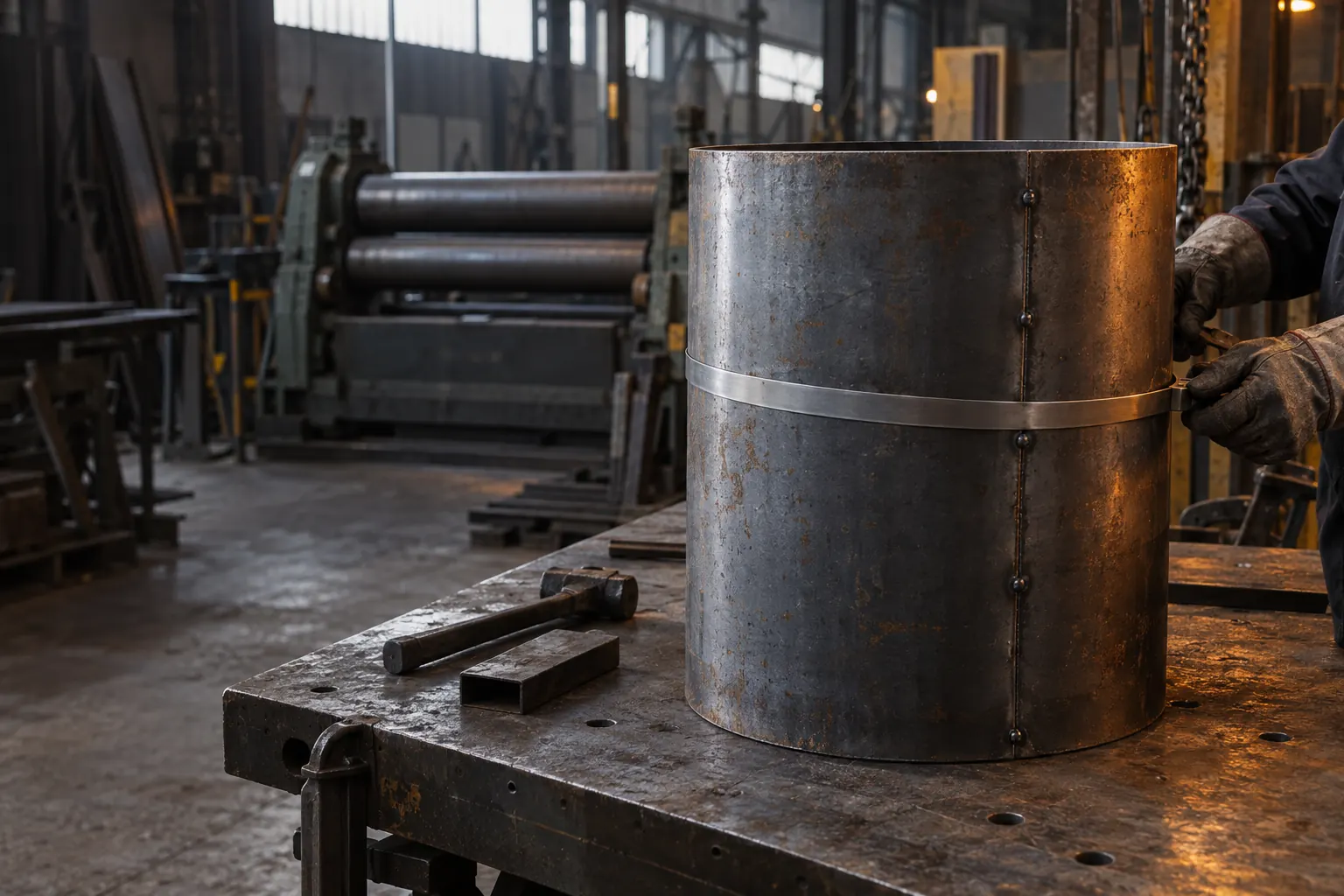
A pipe or rolled shell has three circumferences. The outside one is what a tape reads when you wrap it around the pipe. The inside one is the distance around the bore. The mean one runs through the middle of the wall, and it is the one that matters for rolling: plate keeps about the same length along its middle when it bends, so the flat blank is as long as the mean circumference. The mean circumference is the length of flat plate or sheet needed to roll that cylinder.
Blank length = π x (outside diameter minus the wall) = π x (inside diameter plus the wall).
Worked example
A cylinder 24 in outside diameter with a 3/8 in wall has a mean diameter of 23 5/8 in (23.625). The blank is 74.22 in long, or 74 1/4 in to the nearest 1/16. The outside circumference is 75.398 in and the inside is 73.042 in. The seam gap goes on top of the blank.
- Sized by its inside diameter? Add twice the wall to get the outside diameter, then enter that in the calculator.
- Thick plate rolled to a tight radius can come out slightly shorter than the mean circumference, because the part of the wall that does not stretch moves toward the inside of the bend. Cut a trial piece when the plate is heavy for its diameter.
- Wall thickness by pipe size is in the pipe schedule chart, sheet thickness by gauge is in the sheet metal gauge chart, and the steel weight calculator gives the plate weight once you know the blank.
Out of round pipe or rolled shell
A pipe or shell that has gone oval is still the same length around the wall as it was when it was round, so the diameter it should be is its circumference divided by pi. You do not need a tape around it to find that out: four inside diameter readings, evenly spaced around the pipe, give the same answer. Their average is the true diameter.
Enter what you measured
True diameter and how far out
The average of your 4 readings: 23 11/16 in to the nearest 1/16, or 601.66 mm. This is the diameter the shell has when it is round.
Largest reading (24.0625 in) minus smallest (23.125 in): 15/16 in to the nearest 1/16, or 23.81 mm.
The difference divided by the true diameter.
Worked example
Readings of 23 1/8, 24 1/16, 23 13/16 and 23 3/4 in add up to 94 3/4 in. Divide by four and the true diameter is 23 11/16 in. The largest reading minus the smallest is 24 1/16 minus 23 1/8, which is 15/16 in, so the pipe is 15/16 in (4.0 percent) out of round.
How to take the readings
Measure straight across the inside, through the middle, at one height along the pipe. Take four readings 45 degrees apart: 12 to 6, 3 to 9 and the two diagonals, 1:30 to 7:30 and 4:30 to 10:30. Add them up and divide by four.
Why the average works
Pushing a shell back to round bends it without stretching it, so its circumference stays the same. For any closed shape the circumference is pi times the average of its diameters taken in every direction. Four evenly spaced readings land very close to that average: on a 24 in oval that is about 8 percent out of round, they come within one part in a million of the exact answer.
Pushing it back to round
A spacer cut a little longer than the true inside diameter, jammed across the shell where it measures smallest, pushes the flat side out. The metal springs back some when the spacer comes out, so the overshoot is needed. A common shop rule of thumb is about 1/4 in (6 mm) over on a 2 foot pipe. It is a rule of thumb, not a calculation, and it depends on the material, the wall thickness and how far out of round the shell is. Start short and work up.
Prefer a tape?
Wrap it around the outside, square to the pipe and clear of the weld seam. The outside diameter is the reading divided by pi, and the inside diameter is that minus twice the wall. In the calculator at the top, choose Circumference, type the reading and add the wall thickness.
How much is too much?
It depends on the drawing or the code. A pressure vessel shell built to ASME Section VIII Division 1 can differ by no more than 1 percent of the nominal diameter between its largest and smallest diameter (UG-80), and the example above is well over that. Other work follows its own specification.
From the circle to the cut blank
In the Fabora Steel Tools app, Flat Pattern in Fabora Pro gives the cut blank for cylinders, cones and transitions with a full-size DXF. Tank Volume, which is free, gives the volume of round and rectangular tanks. The app works with no signal on iPhone and Android, and in your browser.


Circumference, diameter and out of round questions
The ones that come up at the tape and the plate rolls, answered with the numbers.
What is the formula for circumference?
Circumference equals pi times the diameter (C = π x D), or two times pi times the radius (C = 2 x π x r). Pi is 3.14159. A 10 in diameter circle is 31.416 in around.
How do you find the diameter from the circumference?
Divide the circumference by pi (D = C divided by π). If a tape wrapped around a pipe reads 60 in, the pipe is 60 divided by 3.14159, which is 19.099 in across.
How do you find the circumference of a pipe?
Use the outside diameter and multiply by pi. A pipe with a 12.75 in outside diameter is 40.055 in around, which is 1,017.4 mm. The inside circumference uses the inside diameter, which is the outside diameter minus twice the wall.
How do you find the diameter of a pipe with a tape measure?
Wrap the tape around the outside, keep it square to the pipe and clear of any weld bead, and divide the reading by pi. That is the outside diameter. Subtract twice the wall thickness for the inside diameter. A pi tape does that division for you, because its marks are already divided by pi.
How do you find the radius from the circumference?
Divide the circumference by 2 x pi (6.28319). A circumference of 60 in gives a radius of 9.549 in.
How long is the plate for rolling a cylinder?
The flat plate is as long as the mean circumference: pi x (outside diameter minus the wall). For a 24 in outside diameter and a 3/8 in wall that is 74.22 in, or 74 1/4 in to the nearest 1/16, before the seam gap. Thick plate rolled to a tight radius can come out slightly shorter, so cut a trial piece when the plate is heavy for its diameter.
What is the mean circumference of a pipe or rolled shell?
It is the circumference measured through the middle of the wall: pi x (outside diameter minus the wall). It sits halfway between the outside and inside circumference, and it is the length of plate or sheet that rolls up into that cylinder.
How do you check whether a pipe is out of round?
Take four inside diameter readings 45 degrees apart: 12 to 6, 3 to 9 and the two diagonals. The largest minus the smallest is how far out of round it is, and dividing that by the average diameter gives the percent. Readings of 23 1/8, 24 1/16, 23 13/16 and 23 3/4 in are 15/16 in, or 4.0 percent, out of round.
How do you find the true diameter of an out of round pipe?
Average the four readings. Pushing a shell back to round bends it without stretching it, so its circumference does not change, and the average of diameters taken evenly around a shape is its circumference divided by pi. The readings above average 23 11/16 in.
How much out of round is allowed?
It depends on the job. For a pressure vessel shell, ASME Section VIII Division 1 limits the difference between the largest and smallest diameter at any cross section to 1 percent of the nominal diameter (paragraph UG-80). A drawing, specification or other code can set a different limit, so check yours before you accept or reject a shell.
How do you push an out of round pipe back to round?
A common shop method is a spacer cut a little longer than the true inside diameter, jammed across the shell where it measures smallest. It pushes the flat side out, and the metal springs back some when the spacer comes out, so the overshoot is needed. A rule of thumb is about 1/4 in (6 mm) over on a 2 foot (600 mm) pipe. It is a rule of thumb, not a calculation: it depends on the material, the wall thickness and how far out of round the shell is.
Does the calculator work in millimeters and fractions of an inch?
Yes. Switch the units to millimeters or inches. In inches you can type a decimal like 23.6875 or a fraction like 23 11/16 or 1-5/16, and the results show inches to the nearest 1/16 as well as to four decimal places.
Where these numbers come from
Every figure on this page is calculated, not copied. Circumference is pi times the diameter and area is pi times the radius squared, with pi taken from the computer's own value (3.141592653589793). Inches and millimeters are converted at exactly 25.4 mm to the inch, the definition agreed in 1959. The nearest 1/16 is the calculated figure rounded, and an exact tie rounds up.
The out of round method rests on Cauchy's formula, which says the circumference of any closed convex shape is pi times the average of its widths taken in every direction. The four-reading average was checked against an exact oval: on a 24 in shell that is about 8 percent out of round it is within one part in a million of the true diameter.
The 1/4 in on a 2 foot pipe for a spacer is a shop rule of thumb passed between fabricators, not a published figure, and it changes with the material. The 1 percent limit for pressure vessel shells is the figure in ASME Section VIII Division 1, paragraph UG-80. Read the current edition for the exact wording and how it is measured, because other codes and drawings set their own limits. Always check a critical dimension on the job.
Fabora Steel Tools
Cut the blank for a cylinder, cone or transition
Flat Pattern in Fabora Steel Tools (Fabora Pro) gives the cut blank for cylinders, cones and transitions with a full-size DXF. Tank Volume, Steel Weight and the Unit Converter are free. It works with no signal on iPhone, Android and in your browser.
Works offlineiPhone, Android and webInches and mm